














Rare Old Map of the Mughal Empire by Clouet, 1787: Delhi, Calcutta, Ganges–Indus, Grand Trunk Rd, Bombay
In unserer Londoner Werkstatt aus der Originalkarte von 1787 restauriert und in Museumsqualität gedruckt. Vollständige Beschreibung
Das Sammlerangebot
Wählen Sie zwei berechtigte Werke und erhalten Sie auf beide 20 % Rabatt. Wählen Sie drei, und das günstigste ist kostenlos – eine maximale Ersparnis von 33 %.
Kombinieren Sie berechtigte Standardkarten und Kunstdrucke nach Belieben. Kein Code erforderlich; das Angebot wird an der Kasse automatisch angewendet.
Standardmäßige Konfigurationen nach Maßanfertigung sind inbegriffen. Maßgeschneiderte Größen, personalisierte Entwürfe und Auftragsarbeiten sind ausgeschlossen.
Benötigen Sie die Lieferung an unterschiedliche Adressen? Kontaktieren Sie uns vor der Bestellung.Das Sammlerangebot
Wählen Sie zwei berechtigte Werke und erhalten Sie auf beide 20 % Rabatt. Wählen Sie drei, und das günstigste ist kostenlos – eine maximale Ersparnis von 33 %.
Kombinieren Sie berechtigte Standardkarten und Kunstdrucke nach Belieben. Kein Code erforderlich; das Angebot wird an der Kasse automatisch angewendet.
Standardmäßige Konfigurationen nach Maßanfertigung sind inbegriffen. Maßgeschneiderte Größen, personalisierte Entwürfe und Auftragsarbeiten sind ausgeschlossen.
Benötigen Sie die Lieferung an unterschiedliche Adressen? Kontaktieren Sie uns vor der Bestellung. In London restauriert • Gedruckt und gerahmt in Canada

Aus der Originalkarte von 1787 restauriert und in Museumsqualität gedruckt. Vollständige Beschreibung
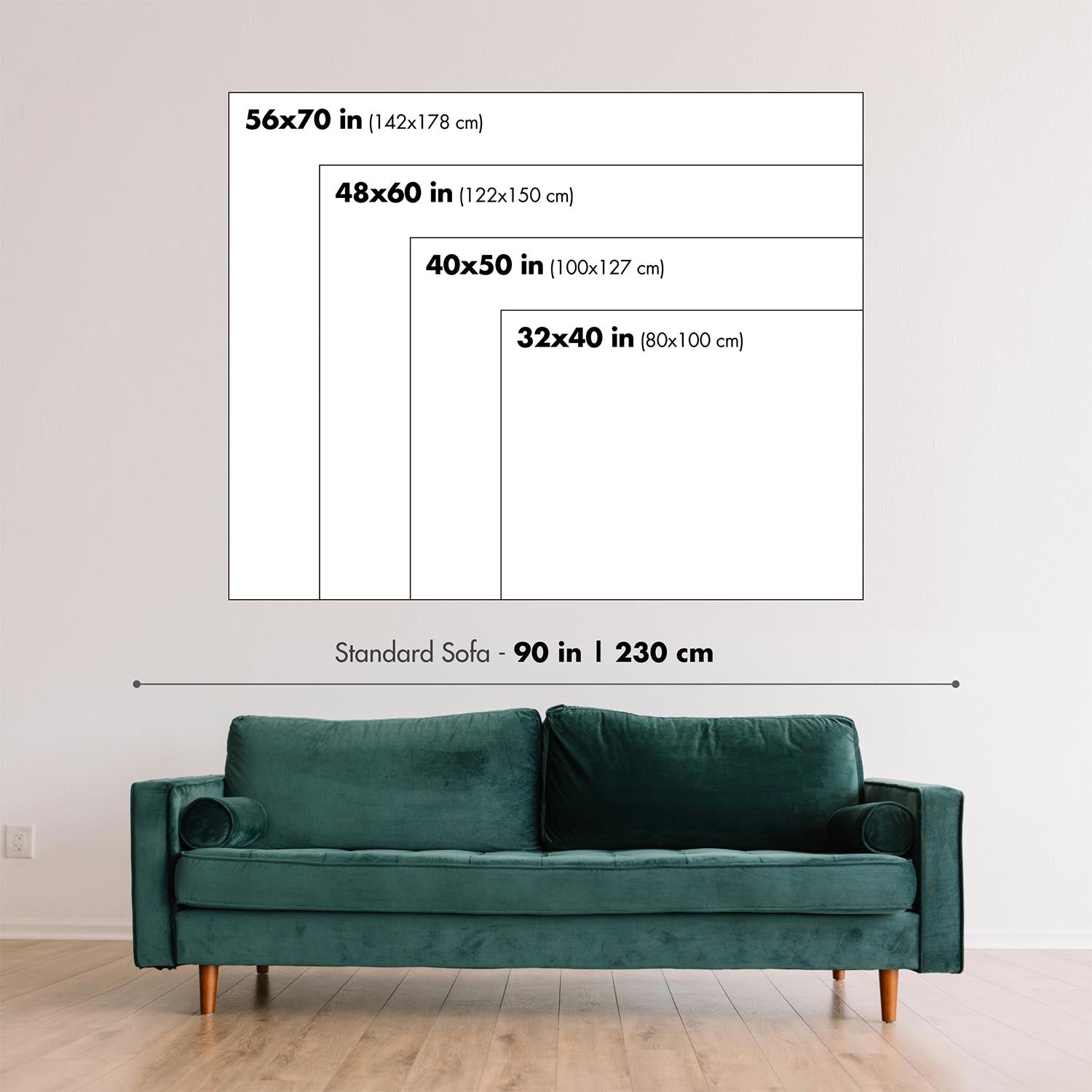
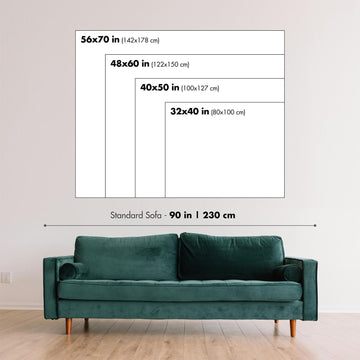
Größe wählen
Ausführung wählen


(Mehr Infos)
Geschenkmitteilung & individuelle Ausführung

Wenn Sie eine Geschenkmitteilung oder eine Ausführung (Puzzle, Aluminiumplatte usw.) hinzufügen möchten, die hier nicht verfügbar ist, geben Sie dies bitte in der "Bestellnotiz" beim Checkout an.
Jede Bestellung wird individuell angefertigt. Wenn Sie die Größe leicht anpassen oder auf einem ungewöhnlichen Material drucken lassen möchten, lassen Sie es uns einfach wissen. Wir haben im Laufe der Jahre Tausende von individuellen Bestellungen bearbeitet, daher gibt es (fast) nichts, was wir nicht bewältigen können.
Sie können uns auch kontaktieren, bevor Sie bestellen, wenn Sie möchten!
Ein Stück Geschichte für Ihr Zuhause
Über 8.000 5-Sterne-Bewertungen


Abbot Jean Baptiste Louis Clouet’s Empire du Mogol, dated 1787, is a masterwork of Enlightenment cartography that marries historical insight with decorative...
WeiterlesenAbbot Jean Baptiste Louis Clouet’s Empire du Mogol, dated 1787, is a masterwork of Enlightenment cartography that marries historical insight with decorative elegance. As Royal Geographer to the Academy of Sciences in Rouen and author of the acclaimed Geographie Moderne, Clouet renders the Mughal realm with an ornate title cartouche and a palette of vibrant, color-coded regions that immediately command attention. The map encompasses the Indian subcontinent—today’s India, Bangladesh, and Pakistan—at a pivotal moment, when South Asia was both a crucible of power and a fulcrum of global trade. Meticulous French annotations, clear boundary lines, and a lattice of travel and trade paths invite the viewer into a richly layered portrait of an empire whose influence radiated far beyond its frontiers.
Geography is the map’s narrative spine. The Ganges and Indus Rivers unfurl like twin arteries, anchoring the agricultural and commercial heartlands from Bengal’s fertile delta to the plains of Punjab and Sindh. Mountain chains, including the Himalayan ramparts framing Kashmir and the northern marches, are crisply modeled, while carefully drawn coastlines along the Arabian Sea and Bay of Bengal emphasize maritime gateways. Notable cities are elegantly symbolized: Delhi and Agra in the imperial core; Lahore and Multan on the overland corridors; Calcutta, Dacca, and Chittagong in the east; Bombay, Surat, and Madras on the coasts; and Hyderabad, Benares, Patna, Jaipur, Kanpur, and others forming a constellation of political and mercantile centers.
Clouet’s color demarcations evoke the Mughal subahs and principal territories, giving form to a political landscape in flux. In 1787, the empire’s authority was waning even as its administrative contours still shaped regional identities—from Kashmir and Sindh to the vast province of Bengal. The map captures this tension: Delhi remains the emblematic seat, yet Calcutta, Bombay, and Madras signal the rising power of European companies, while Hyderabad and Jaipur reflect resilient regional polities. By organizing space through lucid boundaries and captions, Clouet offers a coherent vision of imperial geography at a time of contestation, preserving for European audiences the schema of Mughal governance amid shifting alliances, taxation systems, and competing sovereignties.
Equally compelling are the threads of commerce and movement stitched across the sheet. Indicated trade routes and travel paths shadow the famed Grand Trunk corridor linking Lahore, Delhi, Benares, Patna, and onward to the Bengal ports, while caravan lines through Multan and Sindh suggest overland exchanges with Central Asia. Maritime circuits tie Surat and Bombay to the Arabian Sea and Calcutta, Dacca, and Chittagong to the Bay of Bengal, echoing flows of textiles, fine muslins, indigo, saltpeter, and bullion. The presence of neighboring regions—Tibet and Tartary—situates the subcontinent within a wider Eurasian web, underscoring how Mughal markets and roads channeled ideas, people, and commodities across formidable frontiers.
As art, the map is quintessentially late 18th-century French: a sumptuous cartouche, refined color washes, and crisply engraved typography serve an unmistakably scholarly purpose. Clouet’s design sense—shaped by the decorative tradition of Jean-Baptiste Nolin—never obscures function; symbols for cities and fortresses, careful toponyms, and erudite notes create a document at once beautiful and didactic. For historians, it records contemporary European understandings of South Asia’s political anatomy and commercial lifelines; for collectors, it offers a luminous window onto an empire that fascinated the Enlightenment. Empire du Mogol stands as both a historical witness and a conversation piece, where science, artistry, and global history converge.
Places on this map
- Delhi
- Agra
- Lahore
- Calcutta (Kolkata)
- Mumbai (Bombay)
- Hyderabad
- Benares (Varanasi)
- Surat
- Madras (Chennai)
- Dacca (Dhaka)
- Patna
- Chittagong
- Jaipur
- Multan
- Kashmir
- Sindh
- Bengal
- Kanpur
- Ganges River
- Indus River
Notable Features & Landmarks
- Ornate cartouche with the title "Empire du Mogol"
- Color-coded regions representing different territories and provinces
- Geographical features such as rivers, mountains, and coastlines
- Notable cities marked with specific symbols
- Boundaries of the Mughal Empire as delineated by colored lines
- Indications of trade routes and travel paths
- The inclusion of neighboring regions, like Tibet and Tartary
- Text annotations detailing areas and providing historical context
Historical and design context
- Name of the map: Empire du Mogol
- Mapmaker: Abbot Jean Baptiste Louis Clouet (c. 1730–1790), Royal Geographer for the Academy of Sciences in Rouen
- Date of creation: 1787
- Background: Notable for the multi-volume Geographie Moderne (1776–1793)
- Background: Specialized in decorative wall maps for homes in Paris and Spain; influenced by Jean-Baptiste Nolin
- Topics/Themes: Reflects the Mughal Empire’s geographic and cultural intricacies and its role as a key trade and power center
- Countries/Regions: Depicts the Indian subcontinent, including parts of modern India, Bangladesh, and Pakistan
- Design/Style: Ornate cartography and detailed topographical features typical of late 18th-century mapping
- Historical significance: Demonstrates Clouet’s artistic and cartographic talent and offers insight into mapping practices of the era within the Mughal context
Please double check the images to make sure that a specific town or place is shown on this map. You can also get in touch and ask us to check the map for you.
This map looks great at every size, but I always recommend going for a larger size if you have space. That way you can easily make out all of the details.
This map looks amazing at sizes all the way up to 50in (125cm). If you are looking for a larger map, please get in touch.
This map is wider than most maps, which would make it a perfect statement piece above a mantelpiece, sofa or desk.
The fifth listing image shows an example of my map personalisation service.
If you’re looking for something slightly different, check out my collection of the best old maps to see if something else catches your eye.
Please contact me to check if a certain location, landmark or feature is shown on this map.
This would make a wonderful birthday, Christmas, Father's Day, work leaving, anniversary or housewarming gift for someone from the areas covered by this map.
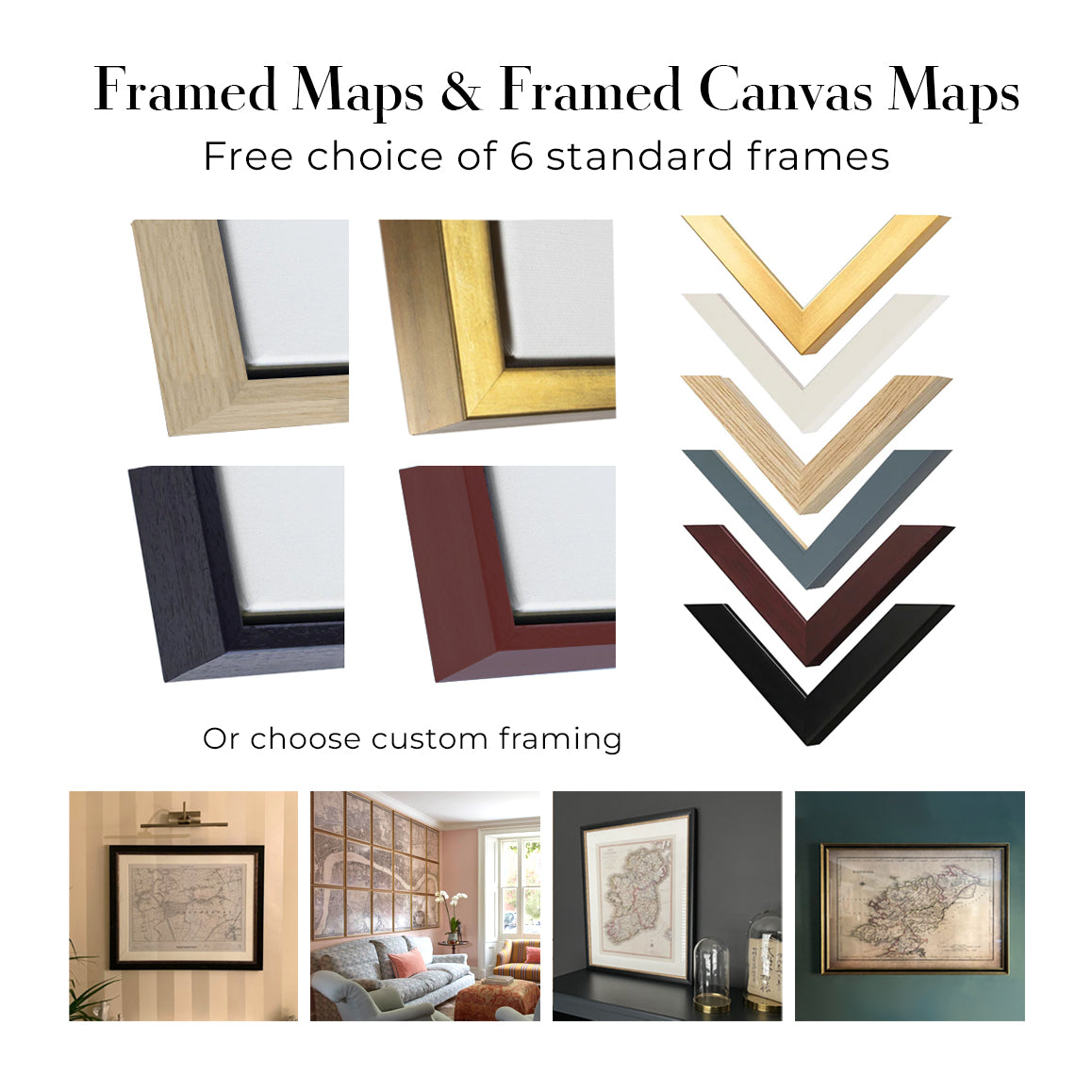
This map is available as a giclée print on acid free archival matte paper, or you can buy it framed. The frame is a nice, simple black frame that suits most aesthetics. Please get in touch if you'd like a different frame colour or material. My frames are glazed with super-clear museum-grade acrylic (perspex/acrylite), which is significantly less reflective than glass, safer, and will always arrive in perfect condition.
This map is also available as a float framed canvas, sometimes known as a shadow gap framed canvas or canvas floater. The map is printed on artist's cotton canvas and then stretched over a handmade box frame. We then "float" the canvas inside a wooden frame, which is available in a range of colours (black, dark brown, oak, antique gold and white). This is a wonderful way to present a map without glazing in front. See some examples of float framed canvas maps and explore the differences between my different finishes.
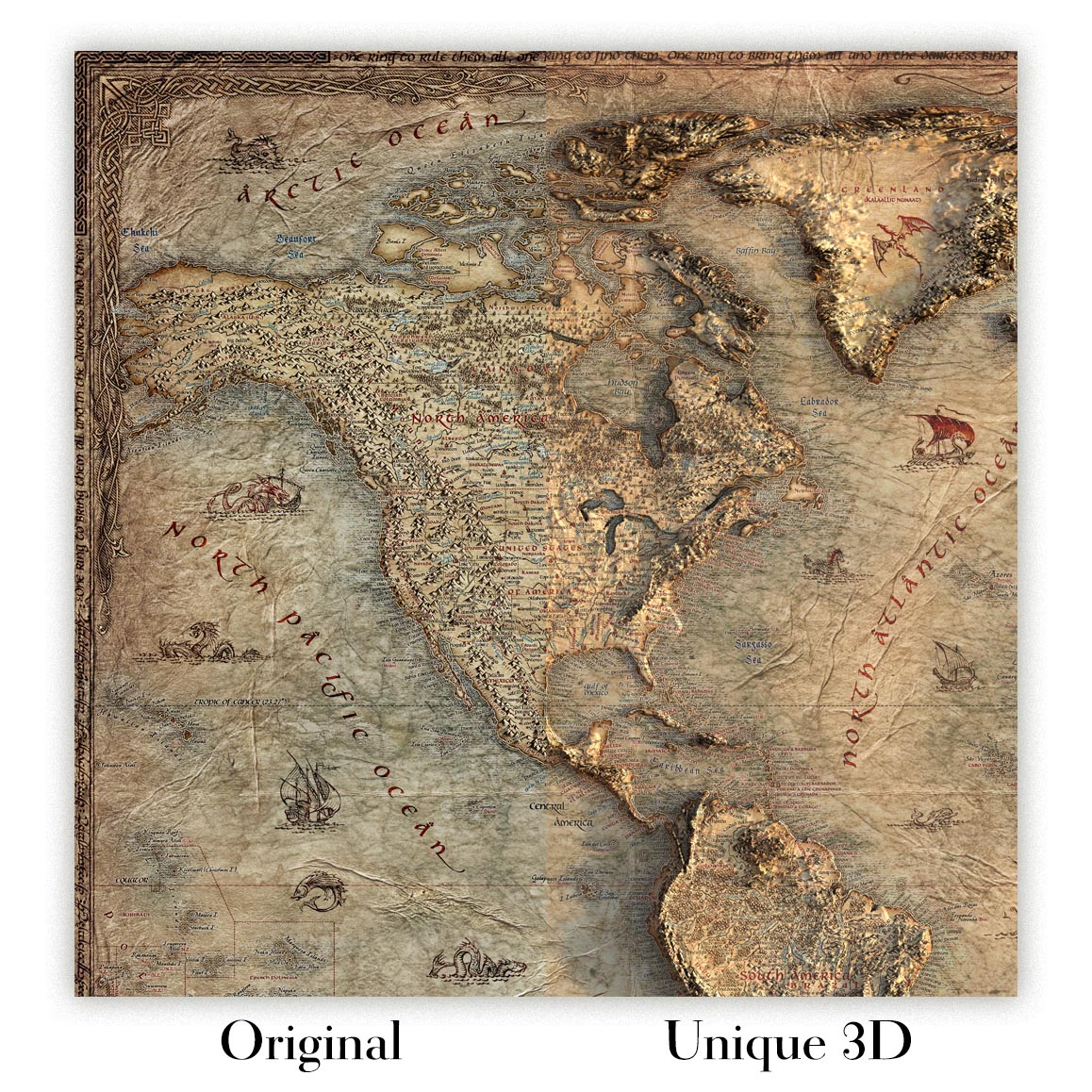
For something truly unique, this map is also available in "Unique 3D", our trademarked process that dramatically transforms the map so that it has a wonderful sense of depth. We combine the original map with detailed topography and elevation data, so that mountains and the terrain really "pop". For more info and examples of 3D maps, check my Unique 3D page.
Abbot Jean Baptiste Louis Clouet’s Empire du Mogol, dated 1787, is a masterwork of Enlightenment cartography that marries historical insight with decorative elegance. As Royal Geographer to the Academy of Sciences in Rouen and author of the acclaimed Geographie Moderne, Clouet renders the Mughal realm with an ornate title cartouche and a palette of vibrant, color-coded regions that immediately command attention. The map encompasses the Indian subcontinent—today’s India, Bangladesh, and Pakistan—at a pivotal moment, when South Asia was both a crucible of power and a fulcrum of global trade. Meticulous French annotations, clear boundary lines, and a lattice of travel and trade paths invite the viewer into a richly layered portrait of an empire whose influence radiated far beyond its frontiers.
Geography is the map’s narrative spine. The Ganges and Indus Rivers unfurl like twin arteries, anchoring the agricultural and commercial heartlands from Bengal’s fertile delta to the plains of Punjab and Sindh. Mountain chains, including the Himalayan ramparts framing Kashmir and the northern marches, are crisply modeled, while carefully drawn coastlines along the Arabian Sea and Bay of Bengal emphasize maritime gateways. Notable cities are elegantly symbolized: Delhi and Agra in the imperial core; Lahore and Multan on the overland corridors; Calcutta, Dacca, and Chittagong in the east; Bombay, Surat, and Madras on the coasts; and Hyderabad, Benares, Patna, Jaipur, Kanpur, and others forming a constellation of political and mercantile centers.
Clouet’s color demarcations evoke the Mughal subahs and principal territories, giving form to a political landscape in flux. In 1787, the empire’s authority was waning even as its administrative contours still shaped regional identities—from Kashmir and Sindh to the vast province of Bengal. The map captures this tension: Delhi remains the emblematic seat, yet Calcutta, Bombay, and Madras signal the rising power of European companies, while Hyderabad and Jaipur reflect resilient regional polities. By organizing space through lucid boundaries and captions, Clouet offers a coherent vision of imperial geography at a time of contestation, preserving for European audiences the schema of Mughal governance amid shifting alliances, taxation systems, and competing sovereignties.
Equally compelling are the threads of commerce and movement stitched across the sheet. Indicated trade routes and travel paths shadow the famed Grand Trunk corridor linking Lahore, Delhi, Benares, Patna, and onward to the Bengal ports, while caravan lines through Multan and Sindh suggest overland exchanges with Central Asia. Maritime circuits tie Surat and Bombay to the Arabian Sea and Calcutta, Dacca, and Chittagong to the Bay of Bengal, echoing flows of textiles, fine muslins, indigo, saltpeter, and bullion. The presence of neighboring regions—Tibet and Tartary—situates the subcontinent within a wider Eurasian web, underscoring how Mughal markets and roads channeled ideas, people, and commodities across formidable frontiers.
As art, the map is quintessentially late 18th-century French: a sumptuous cartouche, refined color washes, and crisply engraved typography serve an unmistakably scholarly purpose. Clouet’s design sense—shaped by the decorative tradition of Jean-Baptiste Nolin—never obscures function; symbols for cities and fortresses, careful toponyms, and erudite notes create a document at once beautiful and didactic. For historians, it records contemporary European understandings of South Asia’s political anatomy and commercial lifelines; for collectors, it offers a luminous window onto an empire that fascinated the Enlightenment. Empire du Mogol stands as both a historical witness and a conversation piece, where science, artistry, and global history converge.
Places on this map
- Delhi
- Agra
- Lahore
- Calcutta (Kolkata)
- Mumbai (Bombay)
- Hyderabad
- Benares (Varanasi)
- Surat
- Madras (Chennai)
- Dacca (Dhaka)
- Patna
- Chittagong
- Jaipur
- Multan
- Kashmir
- Sindh
- Bengal
- Kanpur
- Ganges River
- Indus River
Notable Features & Landmarks
- Ornate cartouche with the title "Empire du Mogol"
- Color-coded regions representing different territories and provinces
- Geographical features such as rivers, mountains, and coastlines
- Notable cities marked with specific symbols
- Boundaries of the Mughal Empire as delineated by colored lines
- Indications of trade routes and travel paths
- The inclusion of neighboring regions, like Tibet and Tartary
- Text annotations detailing areas and providing historical context
Historical and design context
- Name of the map: Empire du Mogol
- Mapmaker: Abbot Jean Baptiste Louis Clouet (c. 1730–1790), Royal Geographer for the Academy of Sciences in Rouen
- Date of creation: 1787
- Background: Notable for the multi-volume Geographie Moderne (1776–1793)
- Background: Specialized in decorative wall maps for homes in Paris and Spain; influenced by Jean-Baptiste Nolin
- Topics/Themes: Reflects the Mughal Empire’s geographic and cultural intricacies and its role as a key trade and power center
- Countries/Regions: Depicts the Indian subcontinent, including parts of modern India, Bangladesh, and Pakistan
- Design/Style: Ornate cartography and detailed topographical features typical of late 18th-century mapping
- Historical significance: Demonstrates Clouet’s artistic and cartographic talent and offers insight into mapping practices of the era within the Mughal context
Please double check the images to make sure that a specific town or place is shown on this map. You can also get in touch and ask us to check the map for you.
This map looks great at every size, but I always recommend going for a larger size if you have space. That way you can easily make out all of the details.
This map looks amazing at sizes all the way up to 50in (125cm). If you are looking for a larger map, please get in touch.
This map is wider than most maps, which would make it a perfect statement piece above a mantelpiece, sofa or desk.
The fifth listing image shows an example of my map personalisation service.
If you’re looking for something slightly different, check out my collection of the best old maps to see if something else catches your eye.
Please contact me to check if a certain location, landmark or feature is shown on this map.
This would make a wonderful birthday, Christmas, Father's Day, work leaving, anniversary or housewarming gift for someone from the areas covered by this map.
This map is available as a giclée print on acid free archival matte paper, or you can buy it framed. The frame is a nice, simple black frame that suits most aesthetics. Please get in touch if you'd like a different frame colour or material. My frames are glazed with super-clear museum-grade acrylic (perspex/acrylite), which is significantly less reflective than glass, safer, and will always arrive in perfect condition.
This map is also available as a float framed canvas, sometimes known as a shadow gap framed canvas or canvas floater. The map is printed on artist's cotton canvas and then stretched over a handmade box frame. We then "float" the canvas inside a wooden frame, which is available in a range of colours (black, dark brown, oak, antique gold and white). This is a wonderful way to present a map without glazing in front. See some examples of float framed canvas maps and explore the differences between my different finishes.
For something truly unique, this map is also available in "Unique 3D", our trademarked process that dramatically transforms the map so that it has a wonderful sense of depth. We combine the original map with detailed topography and elevation data, so that mountains and the terrain really "pop". For more info and examples of 3D maps, check my Unique 3D page.
Viele unserer Karten und Kunstdrucke werden als durchdachte Geschenke für Wohnungen, Büros, Arbeitszimmer und bedeutungsvolle Orte ausgewählt.
Wählen Sie eine gerahmte Option als das einfachste, fertig zum Aufhängen gelieferte Geschenk, oder entscheiden Sie sich für einen ungerahmten Druck, wenn der Empfänger seinen eigenen Rahmen lieber selbst auswählen möchte.
Wir fertigen Bestellungen lokal in 23 Ländern weltweit, sodass Geschenke oft in der Nähe des Empfängers produziert werden können. Das trägt dazu bei, dass sie schneller ankommen, sicherer transportiert werden und Überraschungen durch Zoll oder Einfuhrabgaben vermieden werden.
- Wir können direkt an den Empfänger liefern
- Gerahmte Werke werden fertig zum Aufhängen geliefert
- Ungerahmte Drucke werden sorgfältig in einer stabilen Schutzhülle versandt
- Nahezu jede Bestellung wird lokal gefertigt – für schnelleres und sichereres Schenken
- 90 Tage Rückgaberecht geben dem Empfänger Zeit für seine Entscheidung
Wenn Sie nicht sicher sind, was Sie wählen sollen, kontaktieren Sie uns bitte. Wir helfen Ihnen gern dabei, die passende Karte, Größe, Ausführung oder Lieferoption auszuwählen.
Für die meisten Bestellungen beträgt die Lieferzeit etwa 3 Werktage. Personalisierte und maßgeschneiderte Produkte benötigen länger, da ich die Personalisierung durchführen und sie Ihnen zur Genehmigung zusenden muss, was normalerweise 1 oder 2 Tage dauert.
Bitte beachten Sie, dass sehr große gerahmte Bestellungen in der Regel länger für die Herstellung und Lieferung benötigen.
Wenn Sie möchten, dass Ihre Bestellung bis zu einem bestimmten Datum ankommt, bitte kontaktieren Sie mich, bevor Sie bestellen, damit wir den besten Weg finden können, um sicherzustellen, dass Sie Ihre Bestellung rechtzeitig erhalten.
Ich drucke und rahme Karten und Kunstwerke in 23 Ländern weltweit. Das bedeutet, dass Ihre Bestellung lokal gefertigt wird, was die Lieferzeit verkürzt und sicherstellt, dass sie während der Lieferung nicht beschädigt wird. Sie zahlen nie Zoll oder Einfuhrgebühren, und wir stoßen weniger CO2 in die Luft aus.
Alle meine Karten und Kunstdrucke sind gut verpackt und werden in einem robusten Rohr versendet, wenn sie ungerahmt sind, oder von Schaum umgeben, wenn sie gerahmt sind.
Ich versuche, alle Bestellungen innerhalb von 1 oder 2 Tagen nach Erhalt Ihrer Bestellung zu versenden, obwohl einige Produkte (wie Gesichtsmasken, Tassen und Tragetaschen) länger zur Herstellung benötigen können.
Wenn Sie Express-Lieferung an der Kasse auswählen, priorisieren wir Ihre Bestellung und versenden sie per 1-Tages-Kurier (Fedex, DHL, UPS, Parcelforce).
Nächster Tag Lieferung ist auch in einigen Ländern verfügbar (USA, UK, Singapur, VAE), aber bitte versuchen Sie, früh am Tag zu bestellen, damit wir es rechtzeitig versenden können.
Lesen Sie meinen vollständigen Leitfaden zur Lieferung und lokalen Produktion
Mein Standardrahmen ist ein Galerie-Stil-Rahmen aus schwarzem Eschenholz. Er ist einfach und sieht ziemlich modern aus. Mein Standardrahmen ist etwa 20 mm (0,8 Zoll) breit.
Ich verwende super-klares Acryl (Plexiglas/Acrylt) für das Glas des Rahmens. Es ist leichter und sicherer als Glas – und es sieht besser aus, da die Reflexion geringer ist.
Sechs Standardrahmenfarben sind kostenlos erhältlich (schwarz, dunkelbraun, dunkelgrau, Eiche, weiß und antikgold).
Die meisten Karten, Kunstwerke und Illustrationen sind auch als gerahmte Leinwand erhältlich. Wir verwenden matte (nicht glänzende) Baumwollleinwand, spannen sie über einen nachhaltig beschafften Buchenrahmen und 'schweben' dann das Stück innerhalb eines Holzrahmens. Das Endergebnis ist ziemlich schön, und es gibt keine Verglasung, die im Weg ist.
Alle Rahmen werden "bereit zum Aufhängen" geliefert, entweder mit einer Schnur oder Halterungen auf der Rückseite. Sehr große Rahmen haben schwere Aufhängeplatten und/oder eine Montageschiene. Wenn Sie Fragen haben, können Sie bitte Kontakt aufnehmen.
Sehen Sie sich einige Beispiele meiner gerahmten Karten und gerahmten Leinwandkarten an.
Alternativ kann ich auch alte Karten und Kunstwerke auf Leinwand, Schaumstoffplatten, Baumwollrag und andere Materialien liefern.
Wenn Sie Ihre Karte oder Ihr Kunstwerk selbst rahmen möchten, lesen Sie bitte zuerst meinen Größenleitfaden.
Wir arbeiten mit Innenarchitekten, Unternehmen aus dem Gastgewerbe, Immobilienfachleuten, Büros und Firmenkunden an Einzelstücken sowie an größeren, abgestimmten Projekten.
Diese Karte kann an eine bestimmte Wand, einen Raum oder ein Projekt angepasst werden, und unsere Werkstatt unterstützt Sie vor der Produktion bei der Abstimmung von Abmessungen, Material und Rahmung.
- Exakte, übergroße und maßgefertigte Abmessungen
- Individuelle Rahmung, Montage und alternative Materialien
- Abgestimmte Stücke für mehrere Räume oder Standorte
- Personalisierung der Karte, um wichtige Orte zu markieren oder zusätzliche Details hinzuzufügen
- Beratung zu Karte und Rahmung durch unsere Werkstatt
- Lokale Produktion für Projekte in aller Welt
Besprechen Sie dieses Werk mit unserem Team für Trade & Projects
Meine Karten sind äußerst hochwertige Reproduktionen von Originalkarten.
Ich beziehe originale, seltene Karten aus Bibliotheken, Auktionshäusern und Privatsammlungen auf der ganzen Welt, restauriere sie in meiner Londoner Werkstatt und erstelle dann mit speziellen Giclée-Tinten und -Druckern wunderschöne Karten, die sogar noch besser aussehen als das Original.
Meine Karten werden auf säurefreiem, mattem Archivpapier (nicht glänzend) gedruckt, das sich sehr hochwertig anfühlt und fast wie Karton aussieht. Technisch gesehen beträgt das Papiergewicht/die Papierdicke 10mil/200g/m². Es eignet sich perfekt zum Einrahmen.
Ich drucke mit UV-lichtbeständigen Ultrachrome-Giclée-Pigmenttinten von Epson – einige der besten Tinten, die Sie finden können.
Ich kann auch machen Karten auf Leinwand, Baumwolllappen und andere exotische Materialien.
Erfahren Sie mehr über The Unique Maps Co.
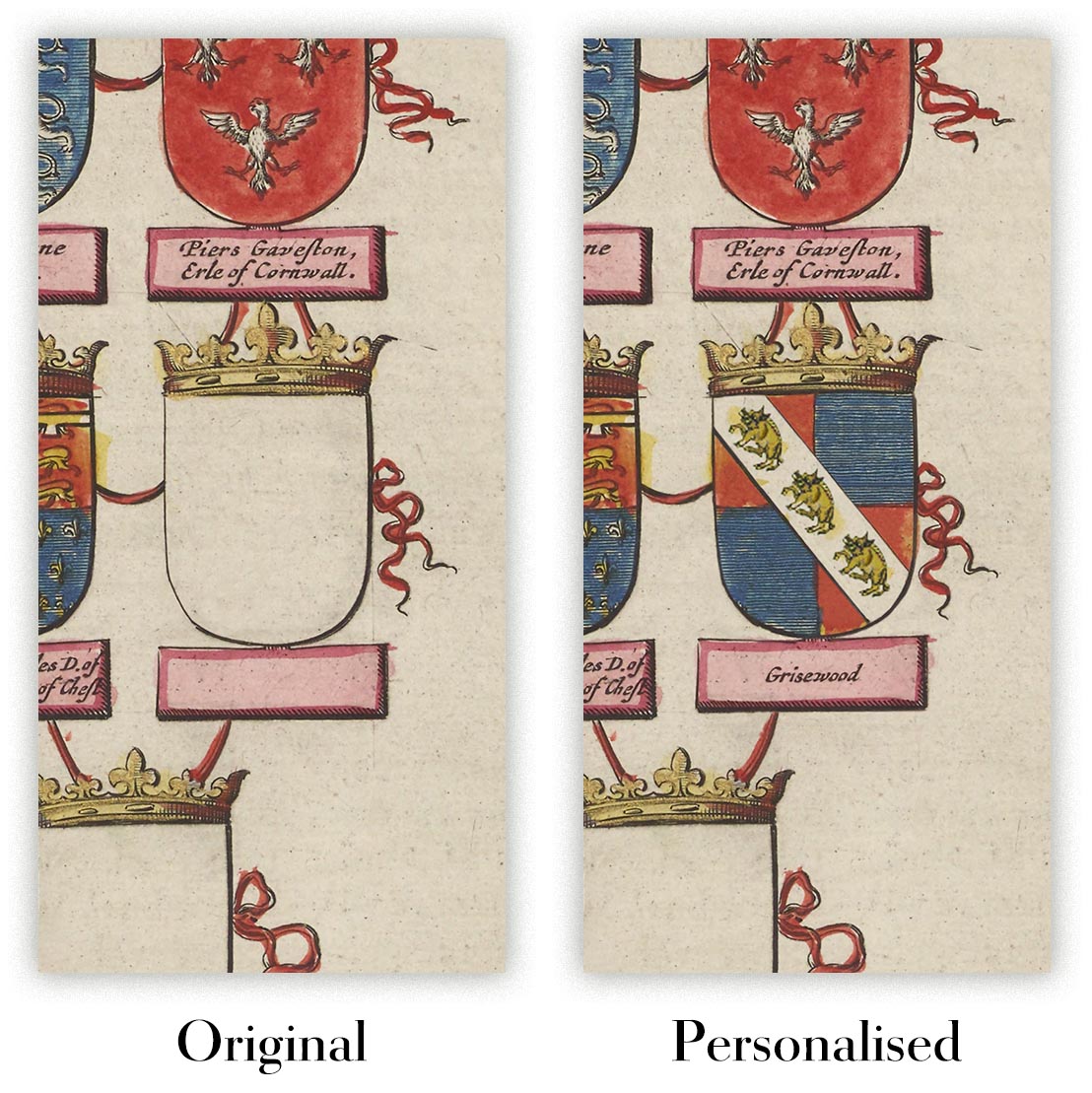
Kartenpersonalisierung
Wenn Sie nach dem perfekten Geschenk zum Jahrestag oder zur Einweihung suchen, kann ich Ihre Karte personalisieren, um sie wirklich einzigartig zu machen. Ich kann beispielsweise eine kurze Nachricht hinzufügen, einen wichtigen Ort hervorheben oder das Wappen Ihrer Familie hinzufügen.
Die Möglichkeiten sind nahezu unbegrenzt. Bitte sehen Sie sich meine Kartenpersonalisierungsseite für einige wunderbare Beispiele dessen, was möglich ist.
Um eine personalisierte Karte zu bestellen, wählen Sie „Personalisieren Sie Ihre Karte“, bevor Sie sie in den Warenkorb legen.
In Kontakt kommen wenn Sie nach komplexeren Anpassungen und Personalisierungen suchen.
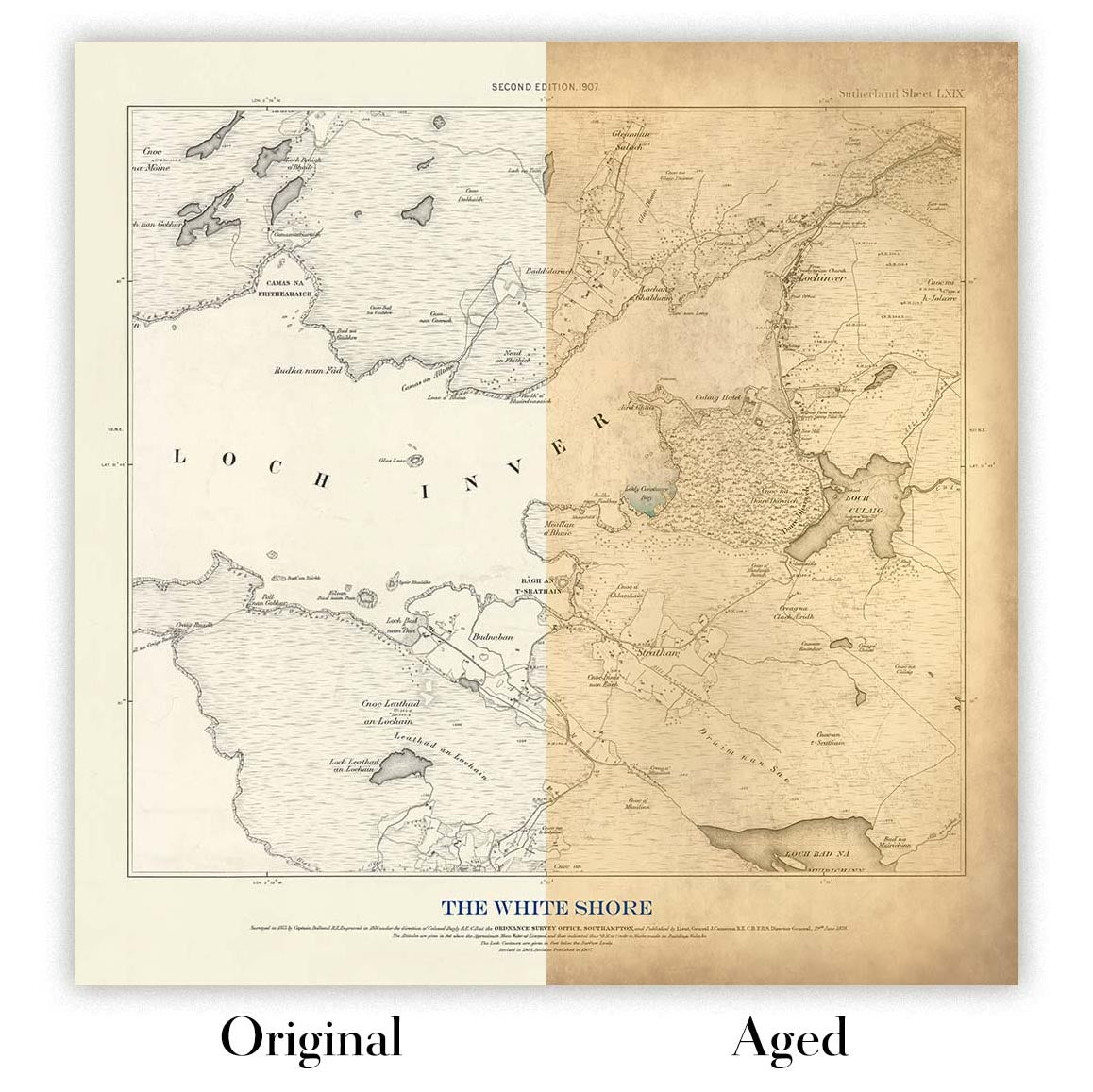
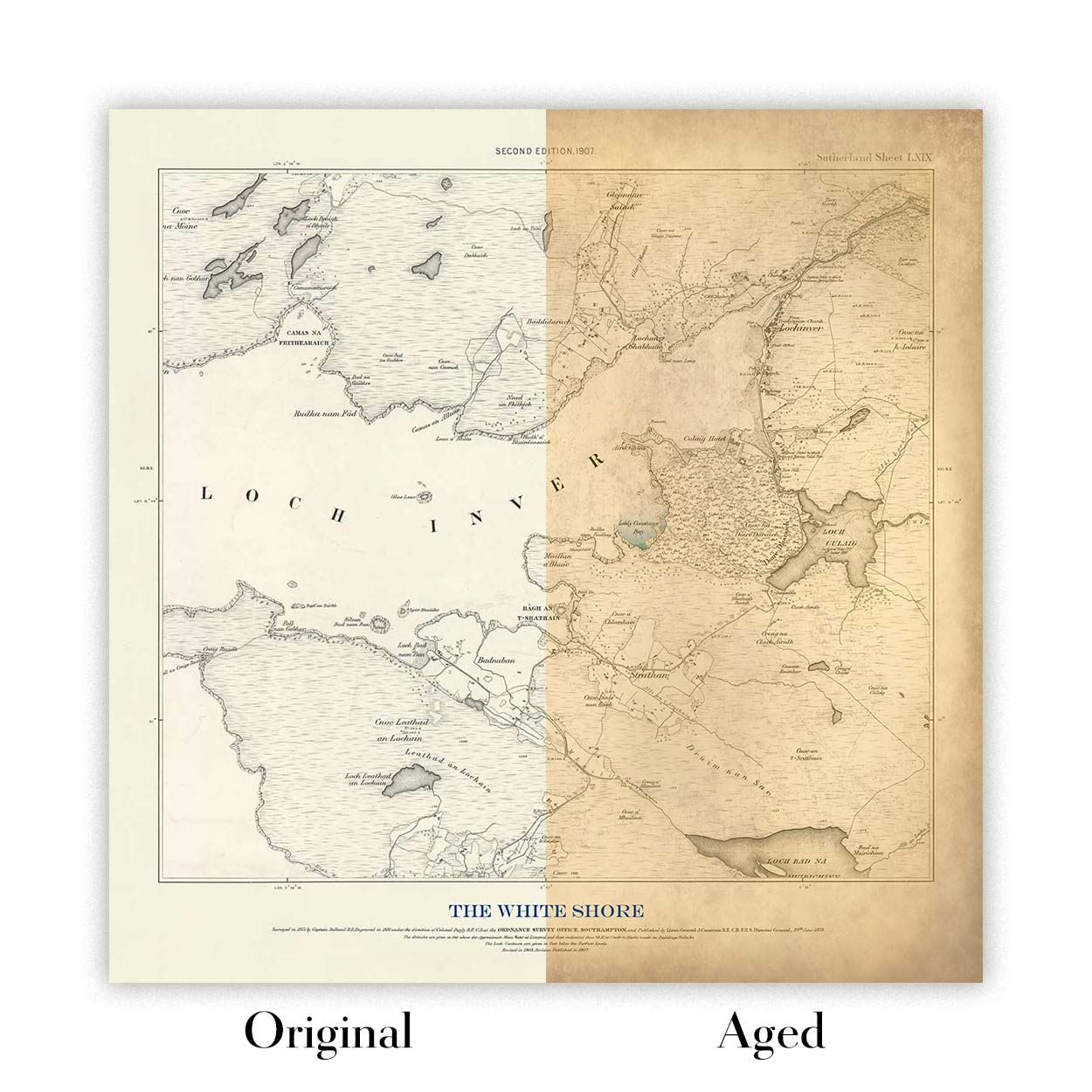
Kartenalterung
Im Laufe der Jahre wurde ich von Kunden hunderte Male gefragt, ob sie eine Karte kaufen könnten, die noch älter.
Nun, jetzt können Sie das, indem Sie „Alter“ auswählen, bevor Sie eine Karte in Ihren Warenkorb legen.
Alle Produktfotos, die Sie auf dieser Seite sehen, zeigen die Karte in ihrer Originalform. So sieht die Karte heute aus.
Wenn Sie „Gealtert“ auswählen, werde ich Ihre Karte von Hand altern lassen. Dazu verwende ich ein spezielles und einzigartiges Verfahren, das ich durch jahrelanges Studium alter Karten und Gespräche mit Forschern zum Verständnis der Chemie alternder Papiere entwickelt habe, und natürlich ... viel Übung!
Wenn Sie sich nicht sicher sind, bleiben Sie bei der Originalfarbe der Karte. Wenn Sie etwas Dunkleres und älter Wenn Sie auf der Suche sind, entscheiden Sie sich für „Aged“.
Sehen Sie einige erstaunliche Beispiele für gealterte Karten.
Seit 1984 restaurieren und fertigen wir Karten und Kunstdrucke an, und wir stehen hinter jedem einzelnen Stück.
Jede Bestellung ist durch unsere 10-Jahres-Garantie und unsere Garantie für beschädigungsfreie Lieferung abgesichert. Sollte Ihr Stück beschädigt bei Ihnen ankommen, ersetzen oder reproduzieren wir es kostenlos. Sollte sonst etwas nicht in Ordnung sein, kontaktieren Sie unser Werkstatt-Team, und wir kümmern uns umgehend darum.
Ausführliche Informationen finden Sie in unseren Rückgabe- und Erstattungsrichtlinien.


