














Rare Old Map of Greece, Albania and Macedonia by Blaeu, 1659: Thessaloniki, Epirus, Pindus Mts, Mt Olympus, Ionian & Aegean
Restored in our London workshop from the original 1659 map and printed to museum-grade archival standards. Full description
The Collector’s Offer
Choose two eligible works and receive 20% off both. Choose three and the lowest-priced one is complimentary, a maximum saving of 33%.
Mix and match eligible standard maps and fine-art prints. No code is required; the offer is applied automatically at checkout.
Standard made-to-order configurations are included. Bespoke sizes, personalised designs and commissioned work are excluded.
Need delivery to different addresses? Contact us before ordering.The Collector’s Offer
Choose two eligible works and receive 20% off both. Choose three and the lowest-priced one is complimentary, a maximum saving of 33%.
Mix and match eligible standard maps and fine-art prints. No code is required; the offer is applied automatically at checkout.
Standard made-to-order configurations are included. Bespoke sizes, personalised designs and commissioned work are excluded.
Need delivery to different addresses? Contact us before ordering. Restored in London • Printed and framed in Canada

Restored from the original 1659 map and printed to museum-grade archival standards. Full description
Choose your size
Choose your finish


(More info)
Gift message & custom finish

If you want to add a gift message, or a finish (jigsaw, aluminium board, etc.) that is not available here, please request it in the "order note" when you check out.
Every order is custom made, so if you need the size adjusted slightly, or printed on an unusual material, just let us know. We've done thousands of custom orders over the years, so there's (almost) nothing we can't manage.
You can also contact us before you order, if you prefer!
Own a piece of history
8,000+ five-star reviews


Macedonia Epirus et Achaia, issued in 1659 by Willem Janszoon Blaeu, surveys the storied northern and western reaches of Greece together with...
Continue readingMacedonia Epirus et Achaia, issued in 1659 by Willem Janszoon Blaeu, surveys the storied northern and western reaches of Greece together with adjoining Albania in a composition as scholarly as it is sumptuous. The eye is drawn first to a baroque cartouche brimming with allegorical figures and scrolling foliage, then out across a landscape animated by ships coursing the Aegean and Ionian waters and oriented by a bold compass rose. Political boundaries are neatly distinguished in color, while rivers, mountain chains, and coastal indentations are crisply named. Small insets introduce supplemental geographic detail, rewarding close study. This is a grand tableau of the Balkans at mid‑seventeenth century, capturing both the contours of power and the textures of place.
Blaeu—luminary of Amsterdam’s Golden Age of cartography—married meticulous measurement with painterly flourish. Trained in the precision-minded milieu that prized astronomical observation and mathematical projection, he distilled a wide array of sources, from classical authorities to contemporary itineraries and maritime charts, into lucid, balanced compositions. His maps were intended to delight the cultivated eye while guiding merchants, diplomats, and scholars through a politically complex, commercially vibrant world. In Macedonia Epirus et Achaia, that dual ambition shows in the careful calibration of toponyms, the measured sweep of coastlines, and the judicious hierarchy of place-names that privileges major ports and passes without sacrificing local texture.
The physical geography is rendered with vigor and clarity. Mountain systems rise in serried hachures—the Pindus forming the spine of Epirus, peaks shading toward the Macedonian hinterland, and storied Olympus looming near the Thessalian borderlands. Rivers carve intelligible corridors: the Axios (Vardar) and Strymon reach the northern Aegean; the Aliakmon meanders toward the Thermaic Gulf; the Aoös (Vjosë) and Arachthos drain Epirus into the Ionian. Lakes and enclosed waters, including the basin at Ioannina and the Ambracian Gulf, punctuate the west. Along the Peloponnesian approach of Achaia, embayments and the narrows near the Gulf of Corinth hint at strategic choke points long contested by traders and empires.
Settlement patterns unfold as a lattice keyed to terrain and sea lanes. Thessaloniki commands the northern seaboard as a mercantile and administrative pivot, while Ioannina nestles amid uplands whose resources and defensibility fostered a distinctive Epirote culture. Achaia’s littoral towns align with fertile plains and river mouths, their fortunes tied to coastal traffic and inland markets. Color-outlined jurisdictions suggest the fluid mosaics of Ottoman provincial governance, even as Venetian influence flickers along the Ionian maritime corridor. Market towns, fortified sites, and monasteries scatter through passes and valleys, revealing the pragmatic logic of movement and security in a rugged landscape.
As a historical document, the map fixes a moment when the Balkans lay at the crossroads of Ottoman administration, Venetian seapower, and enduring classical memory. Its insets invite deeper engagement with contested shores and craggy interiors, while the compass rose and animated shipping scenes evoke a world navigated as much by commerce and curiosity as by conquest. The decorative cartouche—with personifications, trophies, and an elaborate frame—embodies the seventeenth-century conviction that knowledge should be both exact and resplendent. In Blaeu’s hands, geography becomes a theatre of history: borders, rivers, and roads of influence engraved into a portrait of place that remains as instructive as it is beautiful.
Cities and towns on this map
- Thessaloniki (modern-day population: ~315,000)
- Athens (not directly shown, but relevant; modern-day population: ~664,000)
- Ioannina (modern-day population: ~100,000)
- Tirana (not shown, but relevant as a nearby modern city; modern-day population: ~800,000)
Notable Features & Landmarks
- Decorative cartouche featuring figures and an elaborate border.
- Major rivers and mountain ranges are clearly labeled.
- Political boundaries outlined in various colors.
- Insets showcasing additional geographic details.
- Illustrations of ships present in coastal waters.
- Compass rose indicating cardinal directions.
Historical and design context
- Creator: Willem Janszoon Blaeu
- Date: 1659
- Mapmaker Context: Willem Janszoon Blaeu was a renowned Dutch cartographer, known for producing high-quality maps during the 17th century. His work was characterized by meticulous detail and artistic flair.
- Design Style: Intricate detailing, decorative elements, and a baroque cartouche typical of the 17th century; engraving and coloring emphasize rivers and mountains.
- Historical Significance: Reflects 17th-century cartographic knowledge and artistic styles; documents the geopolitical landscape of the time.
Please double check the images to make sure that a specific town or place is shown on this map. You can also get in touch and ask us to check the map for you.
This map looks great at every size, but I always recommend going for a larger size if you have space. That way you can easily make out all of the details.
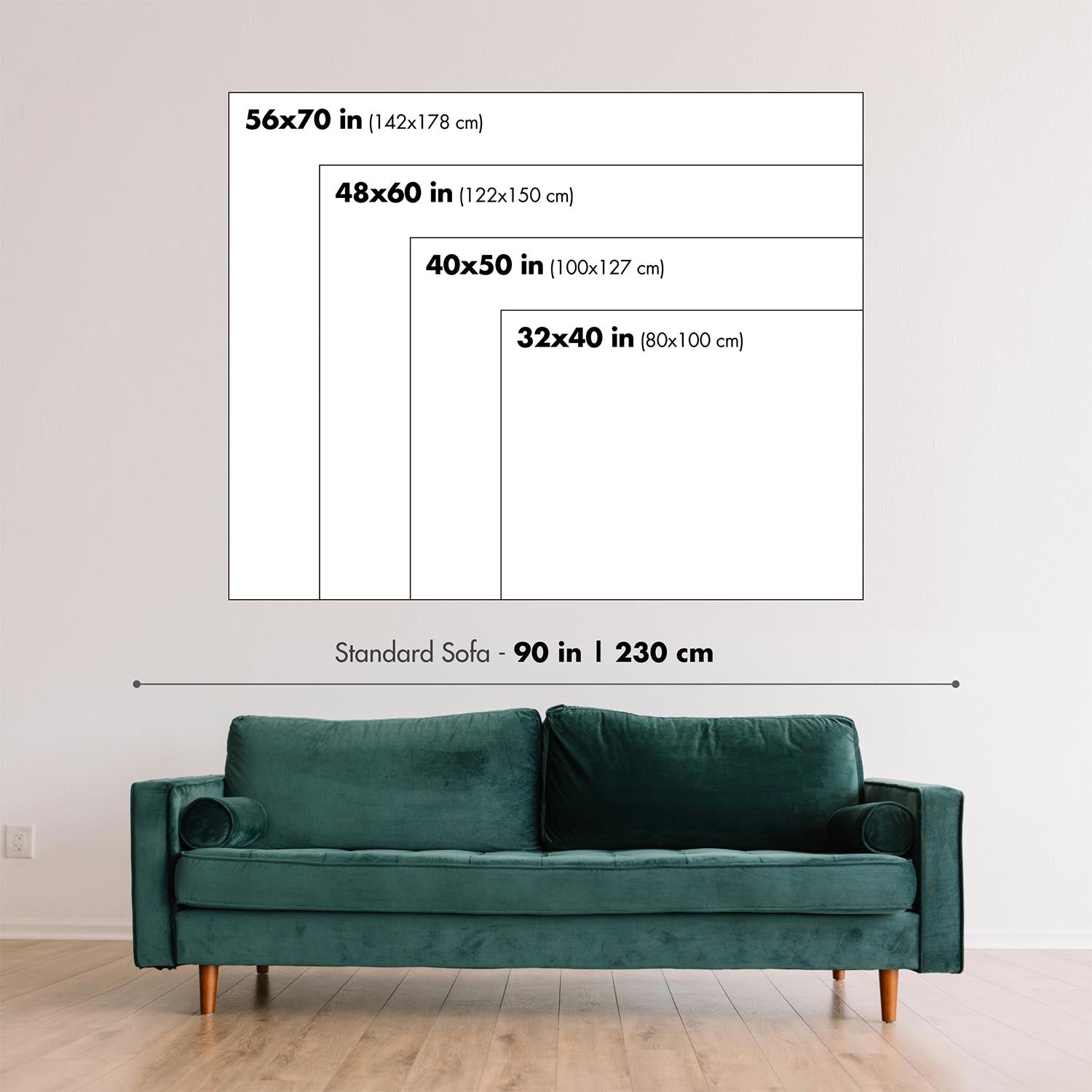
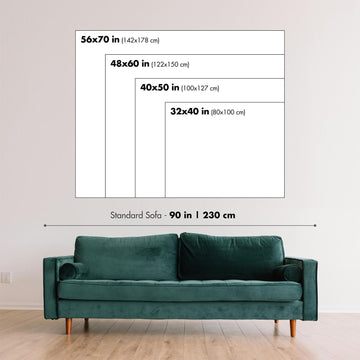
This map looks amazing at sizes all the way up to 90in (230cm). If you are looking for a larger map, please get in touch.
The model in the listing images is holding the 16x20in (40x50cm) version of this map.
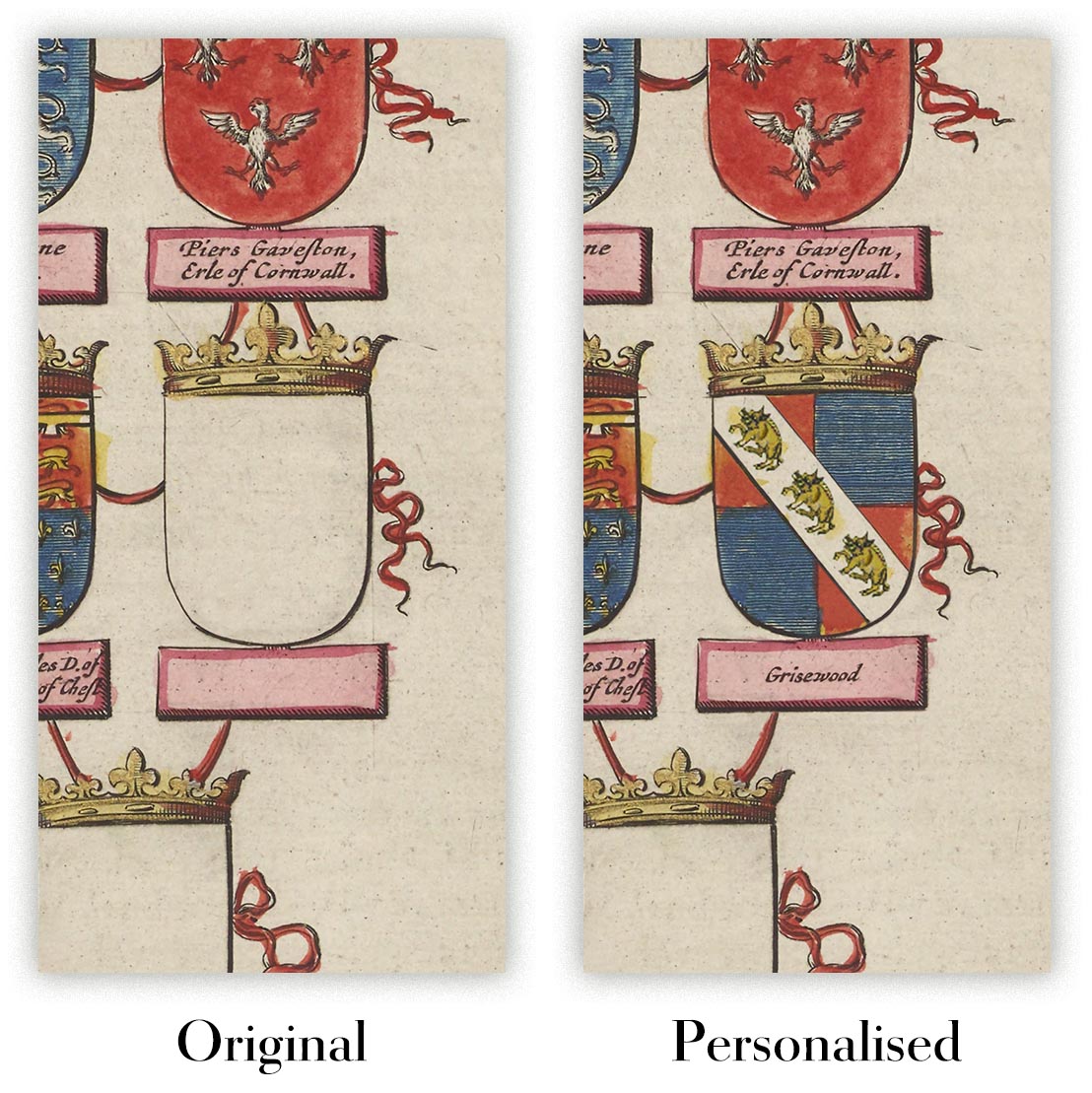
The fifth listing image shows an example of my map personalisation service.
If you’re looking for something slightly different, check out my collection of the best old maps to see if something else catches your eye.
Please contact me to check if a certain location, landmark or feature is shown on this map.
This would make a wonderful birthday, Christmas, Father's Day, work leaving, anniversary or housewarming gift for someone from the areas covered by this map.
This map is available as a giclée print on acid free archival matte paper, or you can buy it framed. The frame is a nice, simple black frame that suits most aesthetics. Please get in touch if you'd like a different frame colour or material. My frames are glazed with super-clear museum-grade acrylic (perspex/acrylite), which is significantly less reflective than glass, safer, and will always arrive in perfect condition.
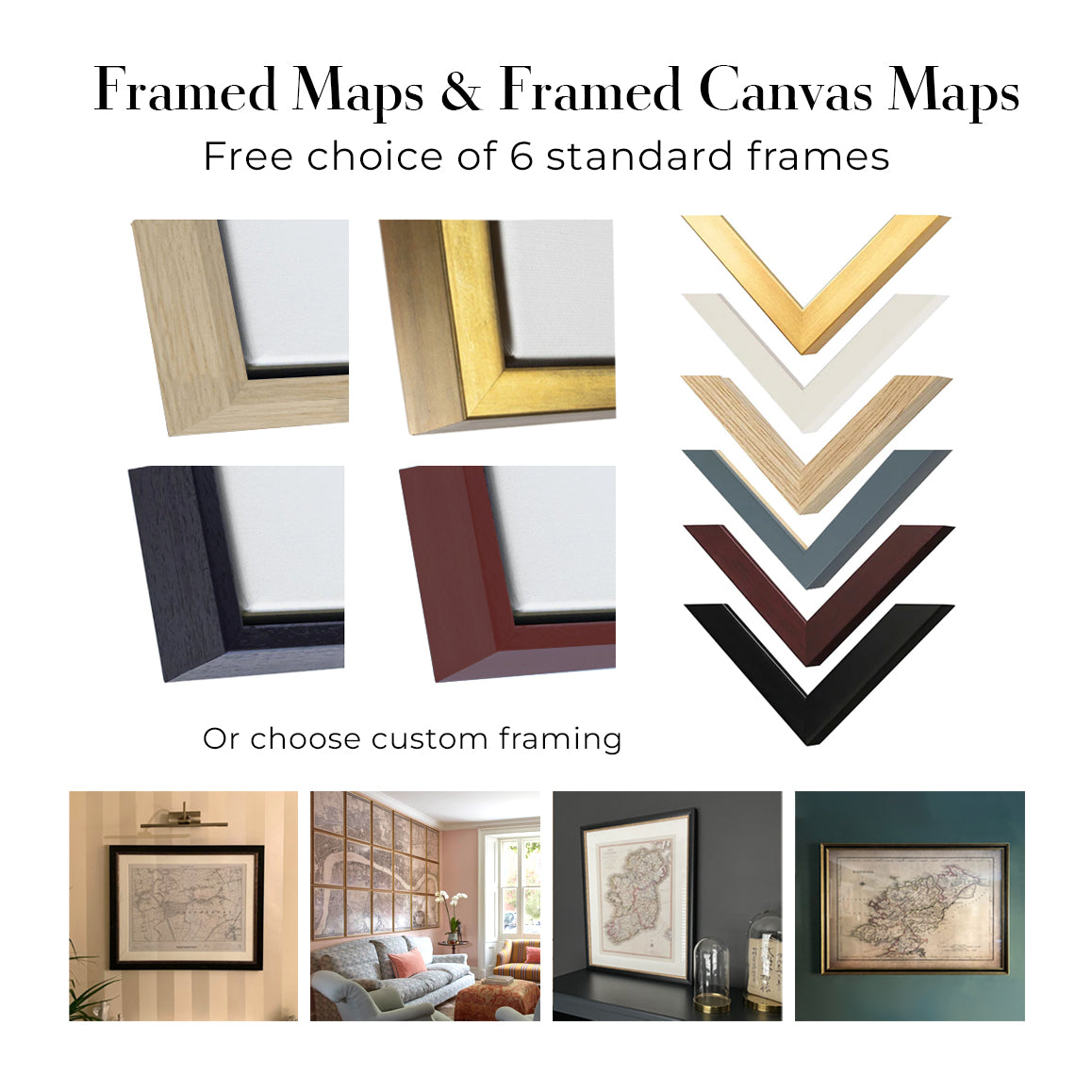
This map is also available as a float framed canvas, sometimes known as a shadow gap framed canvas or canvas floater. The map is printed on artist's cotton canvas and then stretched over a handmade box frame. We then "float" the canvas inside a wooden frame, which is available in a range of colours (black, dark brown, oak, antique gold and white). This is a wonderful way to present a map without glazing in front. See some examples of float framed canvas maps and explore the differences between my different finishes.
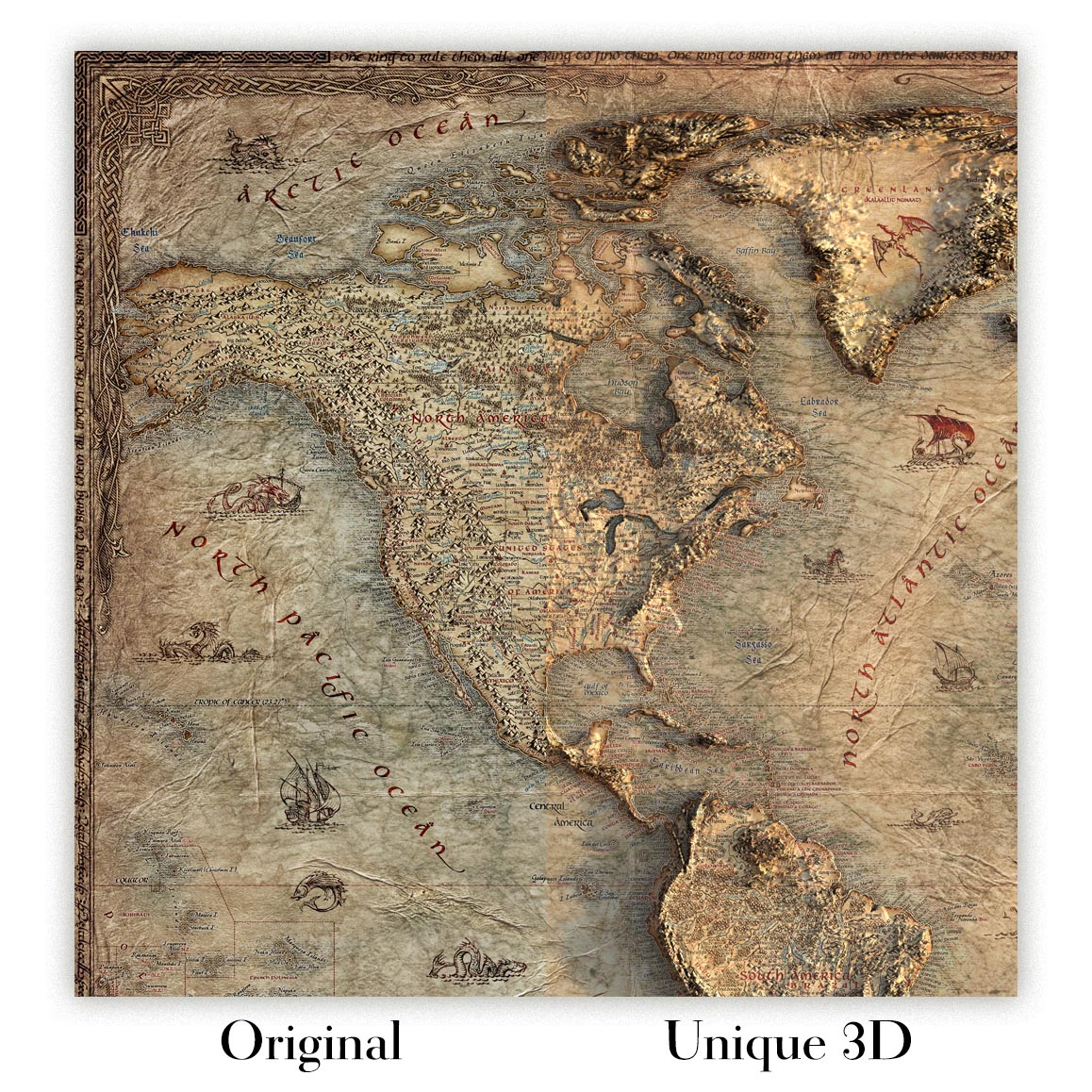
For something truly unique, this map is also available in "Unique 3D", our trademarked process that dramatically transforms the map so that it has a wonderful sense of depth. We combine the original map with detailed topography and elevation data, so that mountains and the terrain really "pop". For more info and examples of 3D maps, check my Unique 3D page.
Macedonia Epirus et Achaia, issued in 1659 by Willem Janszoon Blaeu, surveys the storied northern and western reaches of Greece together with adjoining Albania in a composition as scholarly as it is sumptuous. The eye is drawn first to a baroque cartouche brimming with allegorical figures and scrolling foliage, then out across a landscape animated by ships coursing the Aegean and Ionian waters and oriented by a bold compass rose. Political boundaries are neatly distinguished in color, while rivers, mountain chains, and coastal indentations are crisply named. Small insets introduce supplemental geographic detail, rewarding close study. This is a grand tableau of the Balkans at mid‑seventeenth century, capturing both the contours of power and the textures of place.
Blaeu—luminary of Amsterdam’s Golden Age of cartography—married meticulous measurement with painterly flourish. Trained in the precision-minded milieu that prized astronomical observation and mathematical projection, he distilled a wide array of sources, from classical authorities to contemporary itineraries and maritime charts, into lucid, balanced compositions. His maps were intended to delight the cultivated eye while guiding merchants, diplomats, and scholars through a politically complex, commercially vibrant world. In Macedonia Epirus et Achaia, that dual ambition shows in the careful calibration of toponyms, the measured sweep of coastlines, and the judicious hierarchy of place-names that privileges major ports and passes without sacrificing local texture.
The physical geography is rendered with vigor and clarity. Mountain systems rise in serried hachures—the Pindus forming the spine of Epirus, peaks shading toward the Macedonian hinterland, and storied Olympus looming near the Thessalian borderlands. Rivers carve intelligible corridors: the Axios (Vardar) and Strymon reach the northern Aegean; the Aliakmon meanders toward the Thermaic Gulf; the Aoös (Vjosë) and Arachthos drain Epirus into the Ionian. Lakes and enclosed waters, including the basin at Ioannina and the Ambracian Gulf, punctuate the west. Along the Peloponnesian approach of Achaia, embayments and the narrows near the Gulf of Corinth hint at strategic choke points long contested by traders and empires.
Settlement patterns unfold as a lattice keyed to terrain and sea lanes. Thessaloniki commands the northern seaboard as a mercantile and administrative pivot, while Ioannina nestles amid uplands whose resources and defensibility fostered a distinctive Epirote culture. Achaia’s littoral towns align with fertile plains and river mouths, their fortunes tied to coastal traffic and inland markets. Color-outlined jurisdictions suggest the fluid mosaics of Ottoman provincial governance, even as Venetian influence flickers along the Ionian maritime corridor. Market towns, fortified sites, and monasteries scatter through passes and valleys, revealing the pragmatic logic of movement and security in a rugged landscape.
As a historical document, the map fixes a moment when the Balkans lay at the crossroads of Ottoman administration, Venetian seapower, and enduring classical memory. Its insets invite deeper engagement with contested shores and craggy interiors, while the compass rose and animated shipping scenes evoke a world navigated as much by commerce and curiosity as by conquest. The decorative cartouche—with personifications, trophies, and an elaborate frame—embodies the seventeenth-century conviction that knowledge should be both exact and resplendent. In Blaeu’s hands, geography becomes a theatre of history: borders, rivers, and roads of influence engraved into a portrait of place that remains as instructive as it is beautiful.
Cities and towns on this map
- Thessaloniki (modern-day population: ~315,000)
- Athens (not directly shown, but relevant; modern-day population: ~664,000)
- Ioannina (modern-day population: ~100,000)
- Tirana (not shown, but relevant as a nearby modern city; modern-day population: ~800,000)
Notable Features & Landmarks
- Decorative cartouche featuring figures and an elaborate border.
- Major rivers and mountain ranges are clearly labeled.
- Political boundaries outlined in various colors.
- Insets showcasing additional geographic details.
- Illustrations of ships present in coastal waters.
- Compass rose indicating cardinal directions.
Historical and design context
- Creator: Willem Janszoon Blaeu
- Date: 1659
- Mapmaker Context: Willem Janszoon Blaeu was a renowned Dutch cartographer, known for producing high-quality maps during the 17th century. His work was characterized by meticulous detail and artistic flair.
- Design Style: Intricate detailing, decorative elements, and a baroque cartouche typical of the 17th century; engraving and coloring emphasize rivers and mountains.
- Historical Significance: Reflects 17th-century cartographic knowledge and artistic styles; documents the geopolitical landscape of the time.
Please double check the images to make sure that a specific town or place is shown on this map. You can also get in touch and ask us to check the map for you.
This map looks great at every size, but I always recommend going for a larger size if you have space. That way you can easily make out all of the details.
This map looks amazing at sizes all the way up to 90in (230cm). If you are looking for a larger map, please get in touch.
The model in the listing images is holding the 16x20in (40x50cm) version of this map.
The fifth listing image shows an example of my map personalisation service.
If you’re looking for something slightly different, check out my collection of the best old maps to see if something else catches your eye.
Please contact me to check if a certain location, landmark or feature is shown on this map.
This would make a wonderful birthday, Christmas, Father's Day, work leaving, anniversary or housewarming gift for someone from the areas covered by this map.
This map is available as a giclée print on acid free archival matte paper, or you can buy it framed. The frame is a nice, simple black frame that suits most aesthetics. Please get in touch if you'd like a different frame colour or material. My frames are glazed with super-clear museum-grade acrylic (perspex/acrylite), which is significantly less reflective than glass, safer, and will always arrive in perfect condition.
This map is also available as a float framed canvas, sometimes known as a shadow gap framed canvas or canvas floater. The map is printed on artist's cotton canvas and then stretched over a handmade box frame. We then "float" the canvas inside a wooden frame, which is available in a range of colours (black, dark brown, oak, antique gold and white). This is a wonderful way to present a map without glazing in front. See some examples of float framed canvas maps and explore the differences between my different finishes.
For something truly unique, this map is also available in "Unique 3D", our trademarked process that dramatically transforms the map so that it has a wonderful sense of depth. We combine the original map with detailed topography and elevation data, so that mountains and the terrain really "pop". For more info and examples of 3D maps, check my Unique 3D page.
Many of our maps and art prints are chosen as thoughtful gifts for homes, offices, studies and meaningful places.
Choose a framed option for the easiest ready-to-hang gift, or choose an unframed print if the recipient may prefer to select their own frame.
We make orders locally in 24 countries around the world, so gifts can often be produced close to the recipient. This helps them arrive faster, travel more safely, and avoid customs or import duty surprises.
- We can deliver directly to the recipient
- Framed pieces arrive ready to hang
- Unframed prints are carefully packed in a strong protective tube
- Almost every order is made locally, for faster, safer gifting
- 90-day returns give the recipient time to decide
If you are not sure what to choose, please contact us. We can help you pick the right map, size, finish or delivery option.
Most orders are made locally and delivered in around 2–3 working days, depending on the product, size and destination.
We print and frame maps and artwork in 24 countries around the world, so your order is usually made close to you or your recipient. That means faster delivery, less time in transit, and no customs or import duty surprises.
Personalised and customised pieces usually take an extra 1–2 working days, because we prepare your design and send it to you for approval before printing.
Very large framed orders can take a little longer, as they need extra care in production and delivery.
Every order is carefully packaged: unframed prints are sent in a strong protective tube, while framed pieces are securely packed with protective materials around the frame.
If you need your order by a particular date, please contact us before ordering. We’ll check the best production route and delivery option for your location.
Express delivery is available at checkout for most countries. Next-day delivery is available in the UK, US, Singapore and the UAE.
Your order is covered by our 90-day returns policy and 10-year guarantee.
Our standard frame is a gallery-style black ash hardwood frame, with a simple, modern look. It is approximately 20mm (0.8in) wide. You can also view some lovely customer photos of framed maps and art.
We use super-clear acrylic glazing, also known as Perspex or Acrylite, instead of traditional glass. It is lighter, safer, and has lower reflectivity, giving the artwork a clearer, cleaner appearance.
Six standard frame colours are available at no extra cost: black, dark brown, dark grey, oak, white, and antique gold. Custom framing and mounting/matting is also available for customers looking for something more specific.
Most maps, art prints, and illustrations are also available as a framed canvas. We use matte cotton canvas, stretch it over a sustainably sourced wooden box frame, and then float the piece within a wooden outer frame. The finished result is beautifully presented, with no glazing between you and the artwork.
All frames are supplied ready to hang, with either string or brackets fitted to the back. Very large frames will include heavy-duty hanging plates and/or a mounting baton. If you have any questions, please get in touch.
We can also supply old maps and artwork on canvas, foam board, cotton rag, and other materials.
If you would prefer to frame your map or artwork yourself, please read our size guide before ordering.
We work with interior designers, hospitality businesses, property professionals, offices and corporate buyers on individual pieces and larger coordinated projects.
This map can be adapted for a particular wall, room or project, and our workshop can help coordinate the dimensions, material and framing before production.
- Exact, oversized and made-to-measure dimensions
- Custom framing, mounting and alternative materials
- Coordinated pieces for several rooms or locations
- Map personalisation, to mark important locations or add extra details
- Map and framing guidance from our workshop
- Local production for projects around the world
Every Unique Maps piece begins with an authentic cartographic source or an original design from our London studio.
For our historic maps, we source rare originals from libraries, archives, auction houses and private collections around the world. We carefully restore each map for print—repairing age-related damage, balancing colour and improving clarity while preserving its original detail, texture and character.
Once restored, the map is prepared for your chosen size and finish. Your piece is then printed and, where selected, framed close to its delivery destination.
Our map prints use acid-free 200gsm archival matte paper and fade-resistant pigment inks, creating a rich, non-glossy finish designed to last. Framed maps use crystal-clear optical acrylic and arrive ready to hang.
Canvas, cotton-rag and other specialist presentations are also available. Learn more about our materials and finishes.
Personalising your map
You can add a short title or dedication, mark one meaningful place, or request one considered visual detail. For personalised designs, we send a proof before printing and you can request changes before approval.
For more complex bespoke commissions, contact our design team.
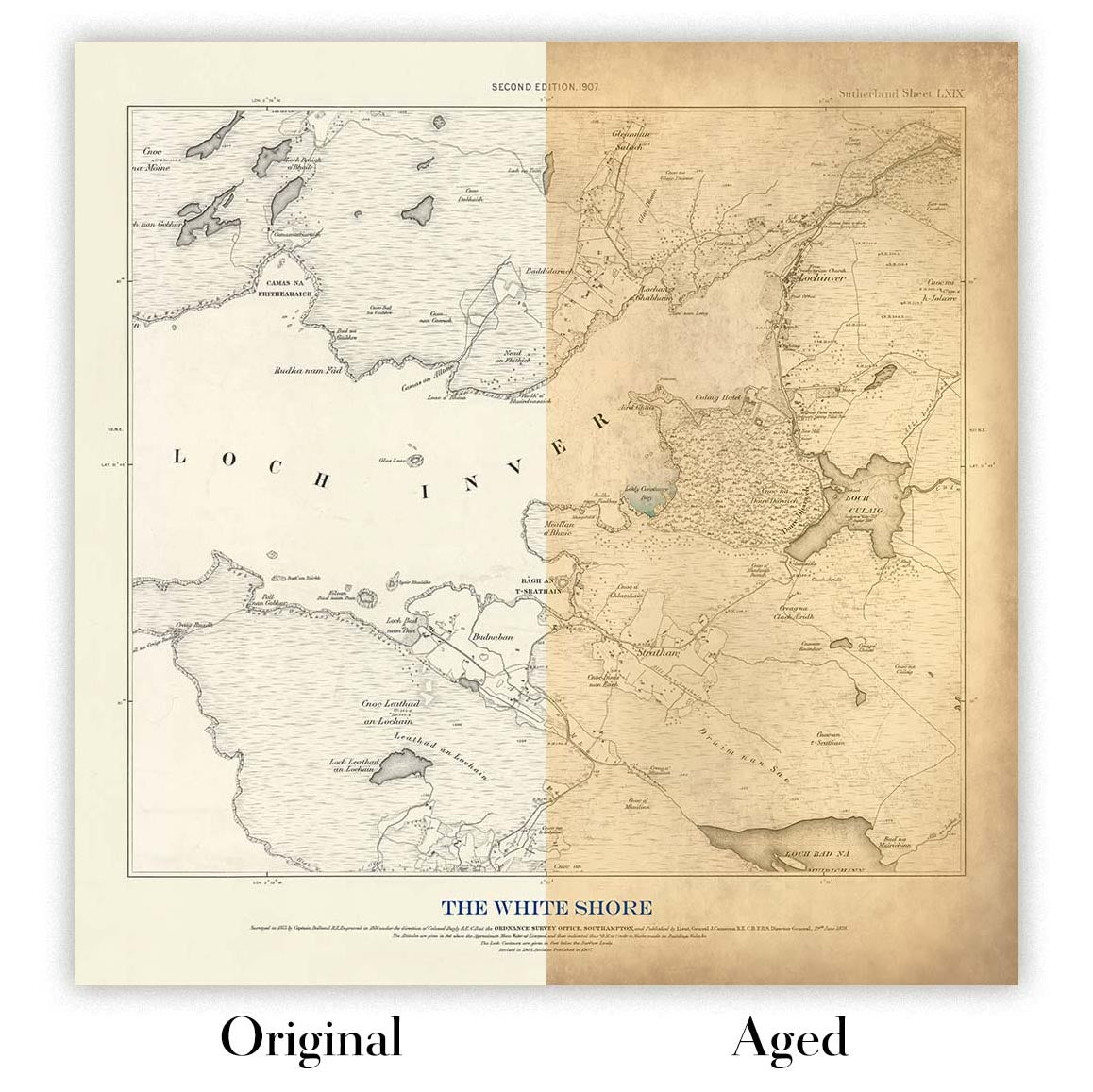
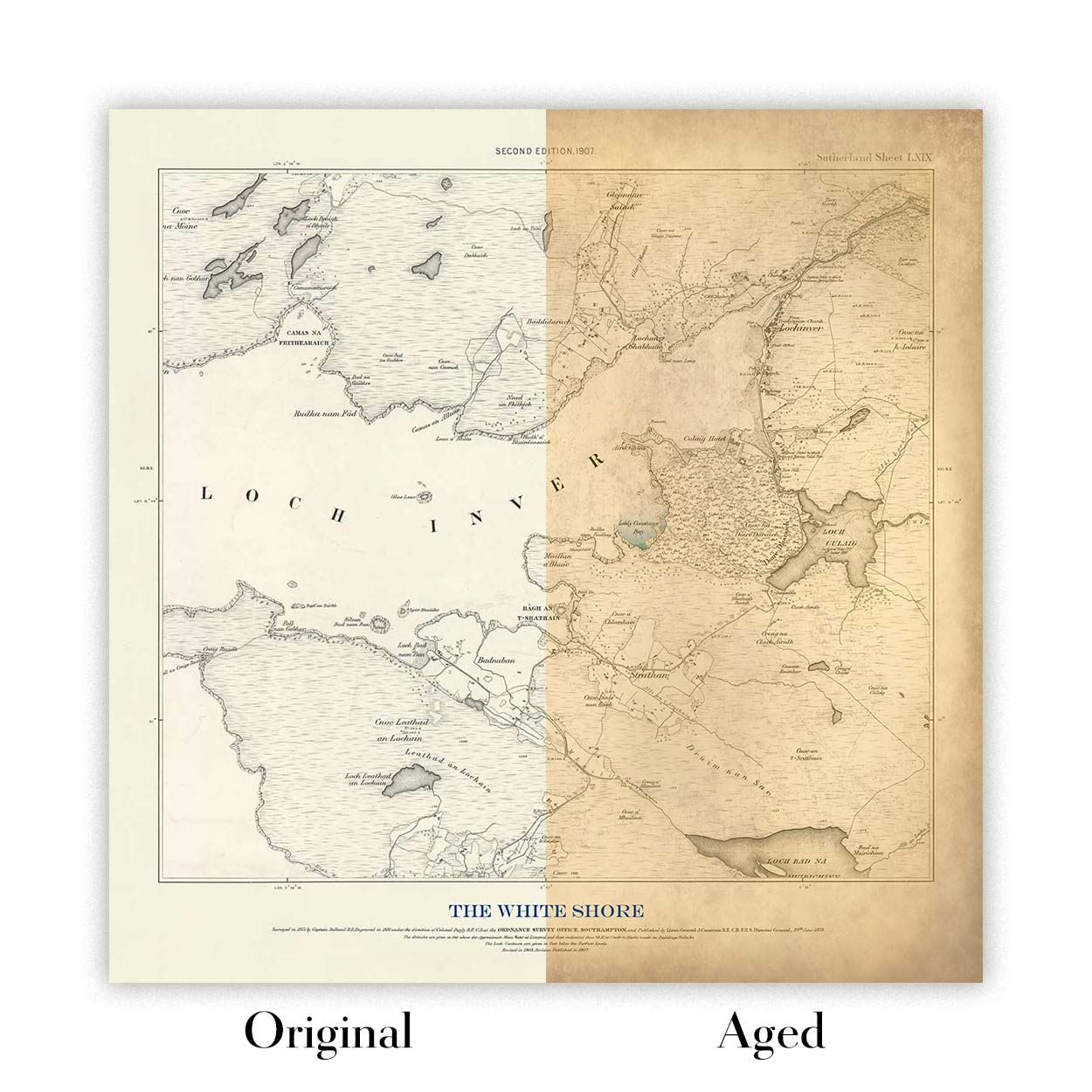
Original or Aged
Choose Original for true-to-source colour, or Aged for a warmer, richer antique character created with our specialist ageing process. See examples of our Aged maps.
We’ve been restoring and producing maps and art prints since 1984, and we stand behind every piece.
Every order is covered by our 10-year guarantee and damage-free delivery guarantee. If your piece arrives damaged, we’ll replace or remake it free of charge. If anything else isn’t right, contact our workshop team and we’ll put it right promptly.
See our returns and refund policy for full details.
Or try searching for something!


